Search

Gregarious Expressions

by Alicia Lynn Grega

Tag

AI

Revising Cressida with Google’s Notebook LM

After seeing the Scranton Shakespeare production of Troilus and Cressida in summer 2019, I began research to support a (feminist) revisionist (live theatre) story about Cressida / Bresis and women trafficked as slaves during the Trojan War. In Chaucer’s version of the Troilus and Cressida story, she is degraded for her disloyalty to Troilus and for her fickle, inconstant character, in general. It’s not a virtuous way for a woman of that time to behave. The readership knows to judge her. Shakespeare plays with moral questions of wartime but doesn’t free Cressida from “slut shaming.”

Peter Donat (left) and Martha Henry in Shakespeare's Troilus and Cressida at the Stratford Festival in Ontario, Canada, 1963.

Unfortunately, after finishing grad school that same summer, my work schedule grew and grew to the scale that I haven’t had much time to devote to this project since first conceiving of its potential.

Among the seven classes I am teaching this semester are an introductory course in Media Writing and Writing for Social Media. Knowing the momentous impact AI continues to have on the media industry, it would disadvantage my students were I not to learn as much as I can first-hand about the potential dangers and benefits of the uncanny elephant in the room. I have my own moral qualms about typing a single word into any of these digital communications platforms these days but … this is the world we are living in today. Is AI going to go away if we ignore it? Can we reject this technology and still expect to earn a living? How long will it take to build a whole new unplugged underground? Are enough of us willing to confront the digital revolution with a new world order? Perhaps.

Like many people, I’ve been captivated with what Google’s Notebook LM can do after hearing the “audio overview” sample on Hard Fork.

While doing research for my class this morning, I was inspired to see what Notebook LM might do with my work on the Cressida Project so far. I’ve accumulated documents including literary research papers, source texts, blog posts and my own notes and creative ideas based on the conviction that we must retell Cressida’s story because she was a trafficked woman, a sex slave traded as a win or loss in a foolishly deadly war waged for no good reason.

Troilus and Cressida in 2012, a collaboration between The Wooster Group and the RSC as part of the World Shakespeare Festival. Photo by Hugo Glendinning © RSC.

After a productive chat and a pretty fantastic “audio overview” was generated, I knew I had to share the results. While these results are AI-generated, they feel very personal and specific to my ideas and viewpoint. I feel a sense of pride in these results even though AI does a lot of heavy lifting here it couldn’t have made sense of my research unless there was something solid here. I fed it 27 sources to support my position and this LM makes it sound like my concept is worth pursuing. I feel re-inspired to finish the work I’ve begun.

The remainder of this post is the content generated by Notebook LM after our detailed conversation. I find it interesting that while the “Audio Overview” leaves out any specific mention of my plans for the revisionist play, the WordPress post I asked Notebook to write did not shy away from my original script in progress. The working title is “Whore Criseyde” which I know is just awful. I’ll change it later LOL.

*The works cited page that supports these footnotes is based on my uploaded sources but also complimented to texts beyond my current download folder. I’m not going to include it here but don’t hesitate to contact me if you are curious.

First: A link to the Audio Overview to help separate the AI that follows from the Alicia who wrote the first half of this post herself.

Audio Overview Logline: “In a reimagining of Shakespeare’s Troilus and Cressida, a woman’s ‘betrayal’ becomes a desperate act of survival in a world where she is both a commodity and a scapegoat for the follies of men.”
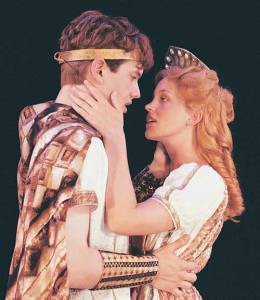
Cameron McNary (left) as Troilus and Tyler Layton as Cressida in Troilus and Cressida, 1999. Utah Shakespeare Festival.

WordPress post I asked Notebook LM to write:

“My current project is a deep dive into the complexities of Shakespeare’s Troilus and Cressida, but it’s not your typical retelling. I’m not interested in simply rehashing the old story of a ‘true’ lover and a ‘false’ maiden. Instead, I want to reimagine Cressida’s story through a feminist lens, exploring her agency (or lack thereof) within a patriarchal and war-torn world. This isn’t just about making her a victim, though. It’s about understanding how she becomes the object of male projections and how her choices are shaped by the impossible constraints placed on her [1-3].

Drawing inspiration from various sources, including the original play and critical analyses [4, 5], I’m particularly interested in:

  • Challenging the traditional narratives: I want to move beyond the simplistic ‘true Troilus, false Cressida’ dichotomy and unpack the societal forces that lead to her condemnation [6].
  • Exploring the idea of Cressida as a commodity: I want to highlight how she is treated as merchandise by men like Pandarus, and how her exchange between the Trojans and Greeks reduces her to an object of political and economic trade [7, 8].
  • Amplifying the voices of the marginalized: I aim to give voice to the women of Troy, including the chorus and the other refugee women, and offer a more nuanced perspective on the impact of war on women [9, 10].
  • Examining the cynical lens of the male gaze: Through characters like Ulysses and Thersites, I want to explore the destructive nature of male cynicism and how it shapes the narrative of the play [11-13].
  • Highlighting the human cost of war: This project is not just about Cressida. It’s about how war dehumanizes individuals and forces them into impossible situations, reflecting a “man-made horror in a godless world” [14-16]. I want the play to be relevant to modern audiences and invite discussion on the timeless themes.

Ultimately, my goal is to create a production that is both faithful to the original text and yet challenges its assumptions, offering a more complete and sympathetic portrayal of Cressida and the women in the play [17]. I am interested in the potential of staging this play with a modern lens, using visual and aural elements to highlight the timeless relevance of its themes [18, 19]. The stage will feature a debris-filled landscape and temporary shelters to emphasise the women’s vulnerability [19, 20]. It will explore the use of hatred as a tool of control [21]. It is a project about what can be ‘taken’ from the experience of the play [22]. I want the play to be an ‘open text’, and I want my production to reflect that.”
Hope for the Humanities?

With the recent media and artist attention to Open AI programs (e.g. ChatGPT and DALL-E) threatening to replace the human acts of creation we assumed for so long could not be automated, I’ve found myself stressing to students that their emotional experience of being alive in this ever-changing world may prove to be their most valuable asset.

I’ve been telling students for years that the unusual things about themselves they tried to hide in high school are extremely valuable in the adult quest to distinguish themselves. In the future, these quirks may be the way we survive.

In a Feb. 2, New York Times opinion piece, David Brooks expresses thoughts along this same line.

“If, say, you’re a college student preparing for life in an A.I. world, you need to ask yourself: Which classes will give me the skills that machines will not replicate, making me more distinctly human?”

-David Brooks, “In the Age of A.I., Major in Being Human

The human skills he cites include: a distinct personal voice, presentation skills, a childlike talent for creativity, unusual worldviews, empathy, and situational awareness. These are skills I’ve been teaching in my college courses for years and hope to keep teaching until I can’t work anymore. But will students getting a degree in order to be employable in specific career tracks recognize the elusive benefits of humanities courses?

Just last week I was speaking to a group of students that people used to want to get an education to expand their minds and world view in order to be better, more advanced human beings. The pressures to live comfortably in capitalist society have turned heads away from any study that does not promise financial profit. Artistic practice and expression, drama and poetry, and the energy of live connection have been so discredited by the system that equates value with money and success with the ability to make large sums of money that a comeback will take time.

Students don’t want to be glued to their phones and screens. They know they spend too much time connected to their devices but don’t know how else to act. They didn’t have an opportunity to get bored as children, to find surprising and creative ways to entertain themselves and pass the time while their parents’ attention was required elsewhere. They grew up with entertainment on demand and video games they could play in the car or grocery store cart. They didn’t have to make up games. Many weren’t allowed to go outside and explore the nooks and crannies of neighborhoods the way their parents and grandparents did.

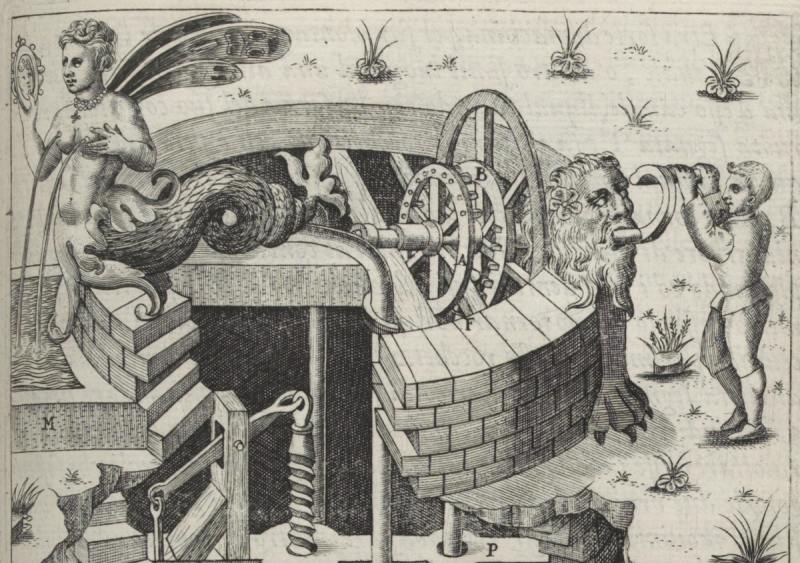
Agostino Ramelli’s 1588 Le diverse et artificiose machine (Diverse and artificial machines) via publicdomainreview.org.

Most of my students hated online pandemic instruction and are genuinely relieved to be coming together with other students in the classroom. They don’t want to invest the time and energy of their youth into a field of study only to be replaced by machines. They have also grown up in educational systems that eliminated art programs and stressed math and science and rigidly conservative rules of language with little reward for individuality and expression. In the worst of cases, they haven’t been taught to think at all, let alone think critically.

I’ve watch students squirm with fear and anxiety when given creative freedom in assignments. Many want to be told exactly what to do with a guarantee that they will get a high score if they follow all the rules to a “T”.

The way things are now, I don’t see capitalism coming around to value people and humanity as much as it values property and profit. People have understandably adjusted their values in order to survive in our capitalist economy but do they know what they’ve given up in order to earn dollars and own things? I’d like to hope that people will choose humanity over technology but the trends of recent decades have shown only the wealthy and powerful will get to enjoy the benefits of natural beauty, whole and organic unprocessed foods, access to the arts, and homemade “artisan” goods. Only the bosses can afford to delegate time spent staring at screens to their subordinates while they travel and talk in person to other bosses. Only youth who can afford access to the arts and can work for years without making money are able to pursue the dream of fulfillment and satisfaction in creative life.

I’m only one of hundreds of thousands of aspiring artists whose wings were clipped by the economic realities of survival under American capitalism in the late 20th and early 21st centuries. Intelligence, talent, education, vision, hard work, discipline – even combined these are no longer enough to secure a stable career.

Revived interest in the humanities should be the result as society inches toward increased computer control of our lives, but unless we demand the poorest and least powerful among us be treated with the same dignity and respect shown to the rich and powerful, only the wealthy will be able to afford such luxurious use of their time.

-ag

Blog at WordPress.com.

Up ↑

Common Play Factory of Scranton

building positive culture for community progress

McLuhan Galaxy

A repository of McLuhan-related news, conferences, events, books, articles, links & general information.

Black Scranton

The Overlooked Community of Scranton, Pennsylvania

Drama Lit Blog 2.0: BU School of Theatre

Curated by upper level Dramaturgy & Literature students of the BU School of Theatre

Seven Kitchens Press

Pie for everyone.

Girls on Fire: Constructions of Girlhood in YA Dystopian Fiction

Women's Studies & Feminist Research and English Studies, Western University

Gagging on Sexism

The good, the bad, and the stupid in manga/anime, movies, books, and more from the view of a feminist

Girls Biking to Work

Practical bicycle fashion for the working Jane

Word Fountain

The Literary Magazine of the Osterhout Free Library

Read On. Write On.

because words have power

Laurie Mac Reads

meandering on & off the page

800 Recovery Hub Blog

Written by people in recovery for people in recovery

Clever Girl Magazine

Journal seeking women's literary submissions...

But I Digress...

Do you walk to school, or do you carry your lunch?

Kindness Blog

Kindness Changes Everything

Kal Spelletich's Art

This is the blog of Kal Spelletich. CONTACT: Spellkal (at) gmail.com + Art, technology, humans and robots, and, well, the journey http://www.kaltek.org/

50 Ordinary Women

doing extraordinary things

undergroundzero

independent theatre festival