
There’s also this authenticity thing where, if I’m playing a piece and it’s not risky for me to do it, if it’s so easy because I know it so well that there’s not risk involved, I feel like I’m cheating the audience and I’m cheating myself.
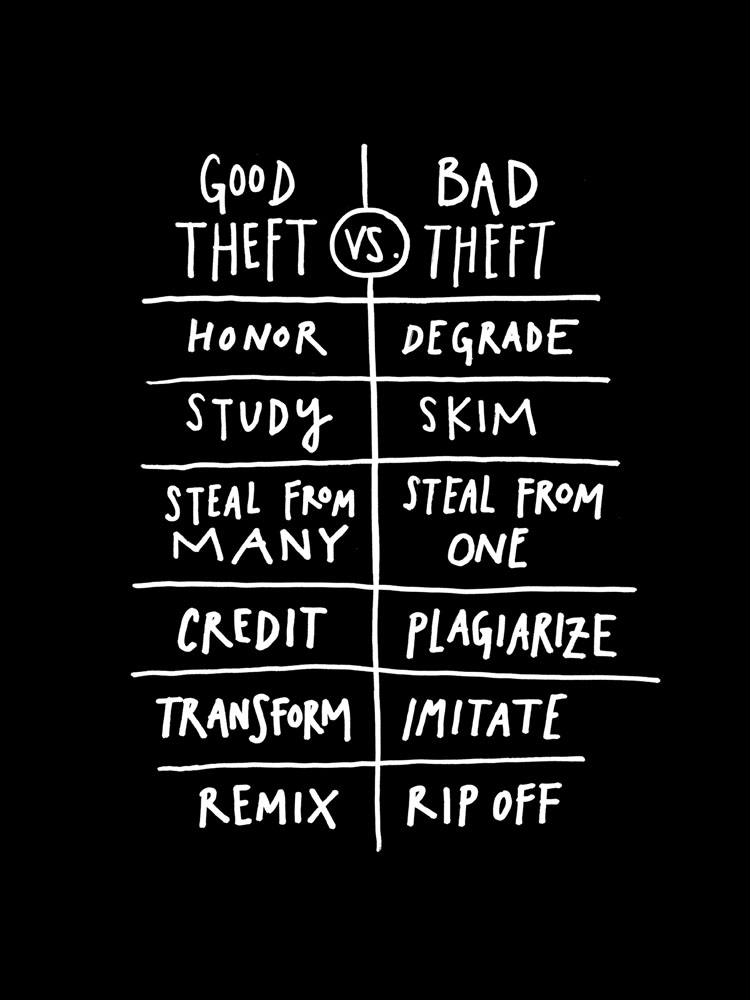
In case you’re having trouble walking the fine grey line, refer to this helpful illustration published last month by American Craft Council with a fantastic article by Austin Kleon, author of Steal Like an Artist, “Nothing Comes from Nowhere.”
– ag
OK. I can’t watch this video. I tried. But I had to press stop after the first sentence.
All this time, I was happy with the memory of that feeling I had stepping off the stage. Relief. Thanks the gods, I pulled it off.
Now I know I messed up THE SECOND WORD. Pretty significant mistake. I don’t want to know how many more I made.
We’re not supposed to see ourselves like this — from the outside, from across the room? I get that same queasy feeling sometimes while driving down the highway at high speed — our bodies weren’t meant to go this fast.
I can’t watch it. But you can, if you want. I never did get around to posting the text of the story. Maybe I still will. Contrary to the point of the event, I think it reads better on the page.
-ag
This authenticity – stripped of pretension – is what my artist colleagues, at least, love about Scranton. It’s been a long slow fight, but I suspect that the tyranny of inferiority that has ignorantly insisted “it can’t be good unless it comes from NYC,” is slowly loosing its suffocating control over our creative horizons.
We are artists and we want to live here. You’d think the city natives would understand that but it’s been a hard sell. It’s simple, there’s more to life, and especially art, than money. -ag
(Richie) Piiparinen recently referenced this trend as “Rust Belt chic” in a post on the blog Rust Wire, describing its allure as “the warmth of the faded, and the edge in old iron and steel … part old-world, working culture, like the simple pleasures associated with bagged lunchmeat and beaten boots in the corner. And then there is grit, one of the main genes in the DNA of American coolness.”
via <a
href=’http://www.salon.com/2012/05/12/rust_belt_chic_declining_midwest_cities_make_a_comeback/’>Rust Belt chic: Declining Midwest cities make a comeback – Dream City – Salon.com.
I had the pleasure of meeting Aaron Landesman at The University of Scranton the week before last and hearing about this latest work in progress first hand. It’s a nice shake up reminding of the many unconventional forms theater can, and some would argue should, take as we move into this uncertain future. Check out this article published at howlround.com yesterday.
-ag
City Council Meeting is taking a form we think we know and asking you to see it differently. Our live event asks you to momentarily own even the most problematic, mundane, “crazy” or sincere views of our fellow citizens, and ask how simply looking each other in the eye can be the beginning of a creative act.What happens next is up to you.
via City Council Meeting: Theater of Tiny Disjuncture by Aaron Landsman | HowlRound.
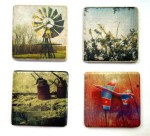
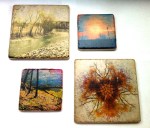
After putting all that time and work into developing the process of creating the abstract architecture tile series last fall it would have been a shame never to pull that trick out of my sleeve again. Especially as I still have a decent amound of acrylic gel medium left.
These images are of two series I’m donating to the First Friday Scranton Art Auction on May 11.
For the first series of images all shot along or near the Lackawanna River trail at Providence Square, I used two six-inch tiles that I’m especially pleased with.
The second series of four four-inch tiles were all shot at my sister’s house in the Quicktown area of Madison Township, just outside of Moscow, Pa.
-ag
 Stumbled across these gorgeous beads by Two Glassy Ladies of British Columbia by accident this morning searching for a Riverdance pic to run in the paper. They’re insanely gorgeous!
I’d love to get my craftly little hands on some.
-ag
Postcard image created for the Jason Miller Playwrights’ Project. The plan is to pass out cards with the Dyonisia ’12
Call for Propsals info on the reverse at our street theater teaser performance of my short apocalypse play I I I me me me I I I at First Friday Scranton on May 4. Look for us on the Renaissance at 500 Plaza.
-ag

 Gregarious Expressions