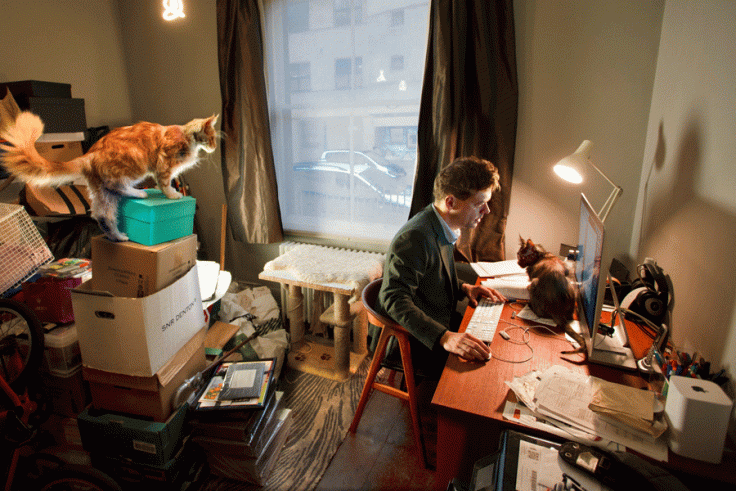
On episode three of season four of the Royal Court Theatre Playwright’s Podcast, Simon Stephens tells guest Stef Smith about the daily automatic writing process he developed with Chris Good.
Every day, he writes, in notebooks, as such:
4 minutes on “Things I remember.”
4 minutes on “Things I notice.”
and 4 minutes on “Things I imagine or intend to do in the future.”
Do you have a daily writing prompt?

It should be clear how the use of such a tool to stay practiced, keep the juices flowing, and just create without the pressure to create within the boundaries of a specific, current work in progress could be helpful to any writing practice.
How much do we see and experience that we just let slip through our fingers that could be woven into great material? Notebooks full of such daily detail and remembered artifacts could be mined on a rainy day when you’re feeling otherwise uninspired. Or what patterns might emerge? What themes?
Try it for a month or if a daily writing practice is not possible within your present circumstances (e.g. you have three jobs, like me), try this prompt instead of not writing at all at the end of a long day when you realize you should sit down to write, but don’t feel like you have the brainpower left to work. Or, if you’d love to write before work but didn’t wake early enough to spare as much as a full half-hour before you have to leave … try it – you only need 12 minutes to connect to your craft and will have an easier time calling yourself a writer in between those open windows of real productivity that result in pages.
-ag
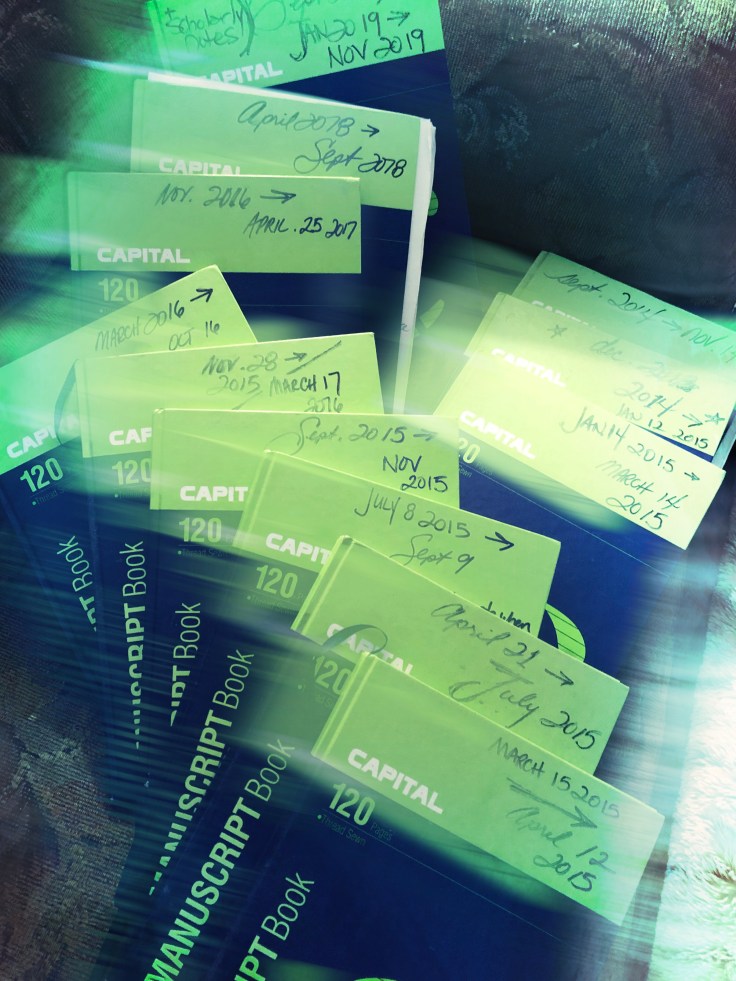
I am going to miss these notebooks …
Found them at Ollie’s for $1.29 years ago and bought the whole case. At first, I used them for various notes but in time they became more precious – designated for emotional outbursts and to write my way out of madness. Less frequently, I took care to note occasional victories or moments of joys. Here and there, evidence of bliss can be found, but more often the words are frustrated, sad, angry and betrayed. They throb with the pain I had to exorcise from my body in order to function.
On one volume, I actually noted for my future dementia-brained self or whatever poor ancestor might have to decide what to do with this mess after I’m gone – “Remember: I only write when it hurts.”
Happiness, humor and hope – the words of my better being – preferred forms of poetry and social posts – not afraid to be seen in public.
There have been many, perfectly peaceful and mundanely serene good days on which I forgot all about me. On some of these days, writing with a clear head and unburdened heart – fiction was born, pages of script were typed and edited. I am most proud of these days. I have worked hard to be free from the damage of chaos, neglect, manipulation, lies and other trauma.
Progress has been made but I am still healing and there will always be bad days. These notebooks have been my closest confidant, journal of tears and fears, hopes and dreams too embarrassing to speak aloud.
Preparing to start a new volume today, I discover there are no more blanks. I don’t know how I will replace them – the weight and quality of these hard cover books are as familiar to me as a lover’s body. Today, I scorn the notion of substitutes with teenage rebellion. In time, I will begrudgingly accept the disappointment of a new compromise. I can’t not write. To live is to continue the story.
I suspect there must be more, older volumes, in the attic – I have a terrible memory, you see, this is also why I write things down. It’s too much of a coincidence these volumes stacked in a corner of my home office should begin and end so neatly with this last, so significant era of my heart-life.
I could not bring myself to read word for word draft prose of the last five years this morning, but I skimmed enough while confirming dates to label volume covers – I have been writing the same story on repeat for five years. Asking the same questions, struggling with the same moral quandaries, praying for the same strength to accept God’s bewildering will and to do the next, best right thing.
There have been moments of variation, of course. But nothing close to shuffle play. The song was a damn good one, too – romantic as fuck, a real tear-jerker – and I still haven’t deciphered the unintelligible lyrics – but the grooves are worn out. The melody has become a warped, diminished version of what it used to be. It’s time to see what’s on the other side of the album.
-ag, one dec 2019

Such a thrill to see the legendary Melanie perform at SteelStax in Bethlehem last night.
I had seen her once before at the Fine Arts Fiesta in Wilkes-Barre, of all places, with my mother, and probably my daughters. It was my mother’s album collection that first turned me on to Melanie when I was of that age we are when we are interested enough in music to start rummaging through our parents’ collections.
Melanie was a poetic and artistic influence in those formative years when I was seeking powerful women with whom I might identify. But she was also a key emotional support during those confusing years I first lived on my own at college. I had a lot of bad days back then – struggling with hormonal mood swings, low self-esteem, and undiagnosed mental issues including OCD (intrusive thoughts) and depression that lead to substance abuse. When I felt really bad, I’d close myself up in a room, blast Melanie records and sing at the top of my lungs. Like I had to expunge the emotions or I might explode. I recognized it when I saw Bridget Fonda listen to Nina Simone in the Americanized-version of La Femme Nikita, Point of No return. Melanie was to me what Nina Simone was to Fonda’s character.

It was more than kind of my mother to purchase tickets for her and I and my sister to experience Melanie live in the cozy Musikfest Cafe. My mother and I love each other deeply, but we often fail to connect. Melanie’s music is a clear thread. We could agree on this thread even as I often hold my breath for fear of political landmine slippage. The fourth ticket went to an old friend of my mother’s who had introduced her to Melanie. A man known then by the telling nickname “Flower Power.” He’s the first person I remember talking to in person who was actually at Woodstock. And after we got to hear his wild story over dinner, we got to hear Melanie share hers between songs.
She was only 22 years old when she played at Woodstock. Filling in for the Incredible String Band who did not want to play in the rain for fear of electrocution, Melanie took the stage a nobody and seven songs later, left a celebrity. She told us about a spiritual experience she had after sitting alone in a small, empty tent backstage for hours before finally walking up the ramp to the stage. She left her body in front of all those people before opening her mouth to sing. I wanted to see it.
Why hadn’t I seen the footage of Melanie performing at Woodstock before, I wondered. Only fans have. Comments on the video below mention that she was cut from the movie. I didn’t shout out a request for “Tuning My Guitar” at the show last night, but it’s long been my favorite. I hadn’t realized she performed it at Woodstock 50 years ago. No wonder they fell in love with her.
This song has helped me tremendously over the years – to remember that it is okay to take time for myself. That I can and should take those moments of self-care, to make myself fit to be a person who can produce and thrive and on the best days, be a good role model myself.
Thank you, Melanie. Thank you, Mommy.
You might be an academic if …
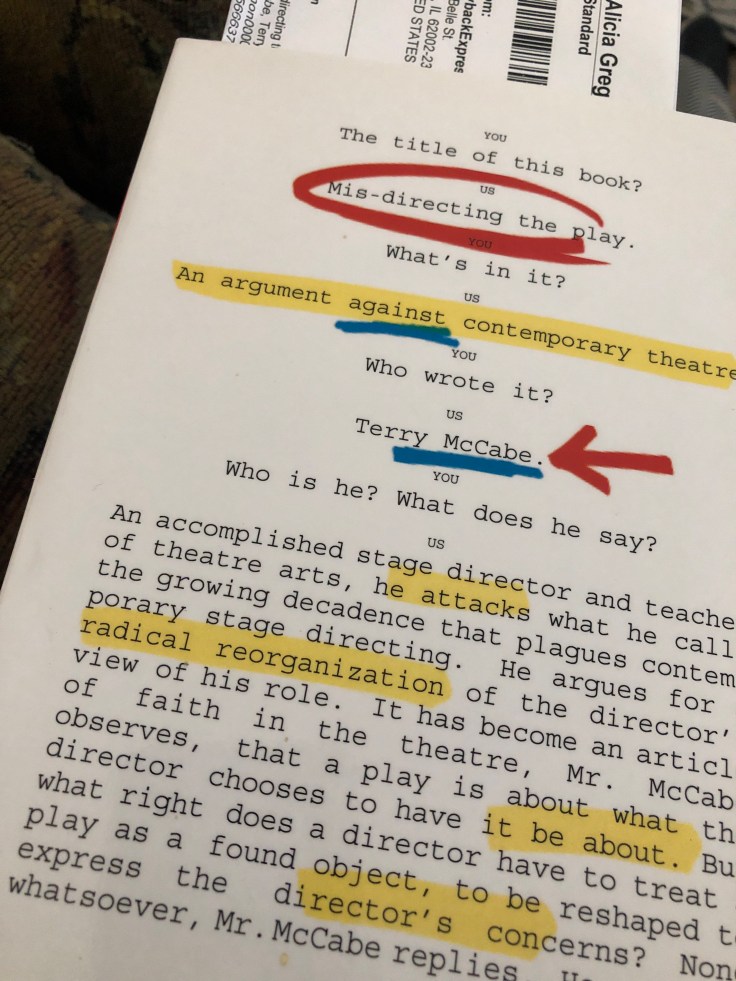
Your reward for grading papers is getting to sink your brain a book you imagine quoting in a philosophical statement regarding your approach to making theater and the non-hierarchical playmaking company you founded inspired by decades of research into matriarchal aesthetics.

“Writing for film is like being a sperm donor. They absolutely need you. They can’t do it without you, but once you’ve done your thing (they never want to see you again.) And don’t come to the birthdays – that’s weird if you show up for the birthday. You won’t be invited along.
(Do it in a room on your own.) And when you’re finished leave. And as you leave they sort of look at you like what kind of sick bastard does that for a living.”
– Jez Butterworth in an interview with Simon Stephens for the Royal Court Playwright’s Podcast, S3 Ep. 1, Jan. 3, 2019.
(Words in parentheses spoken by Simon Stephens.)

7 to 8:30 p.m. Thursday, May 16. Service by Alicia Grega. Directed by Rusty Thelin.
All performances are in the Rauh Blackbox located on the 3rd floor of the New Pittsburgh Playhouse @ Point Park University. Enter at 414 Wood Street and go through the University Center to the theatre. All performances are free of charge.
#pointparkuniversity #mfa #thesis #pittsburgh #pittsburghplayhouse #serviceTV #pilot
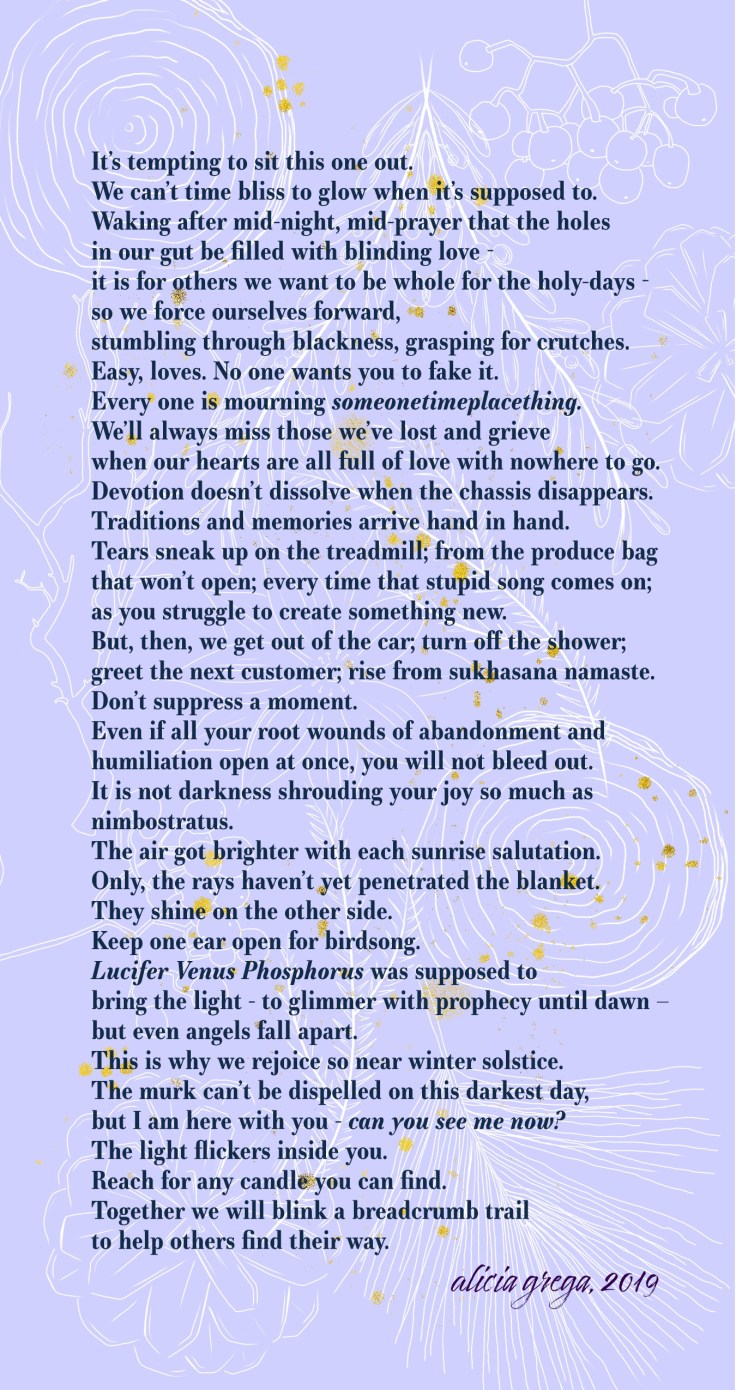
Merry Christmas, Friends!
The first line is a nod to an untitled Rachel McKibbens poem I haven’t been able to get out of my head since I heard it years ago. The rest is me. -ag