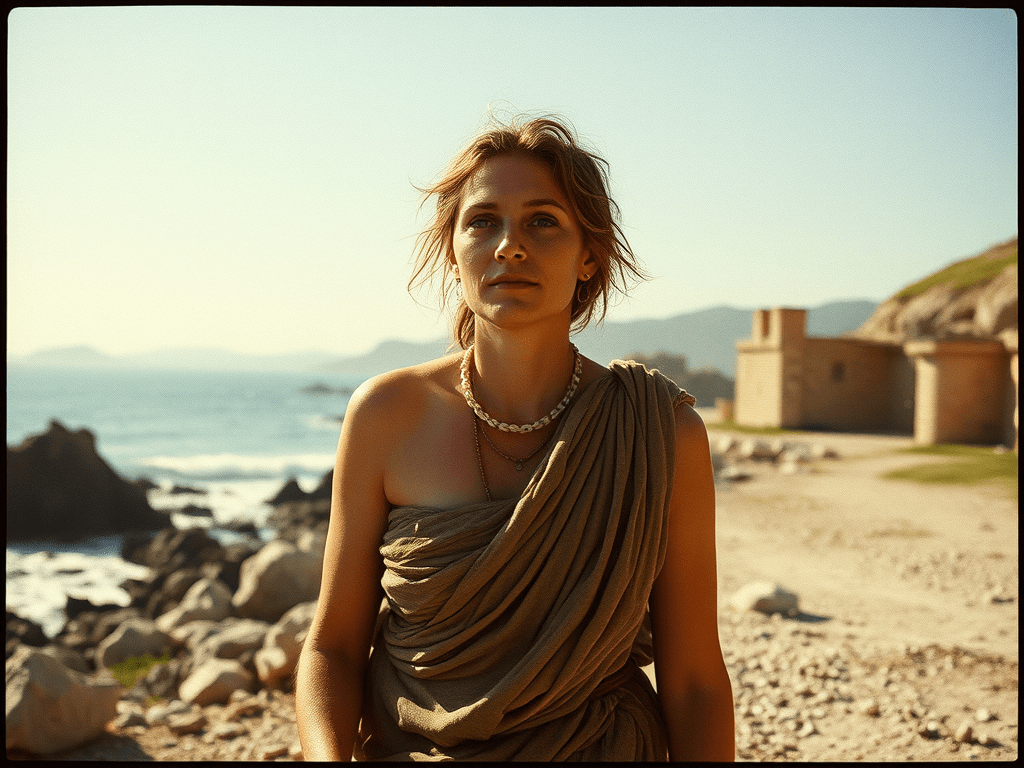
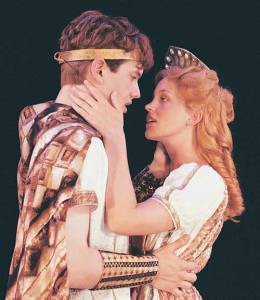
After seeing the Scranton Shakespeare production of Troilus and Cressida in summer 2019, I began research to support a (feminist) revisionist (live theatre) story about Cressida / Bresis and women trafficked as slaves during the Trojan War. In Chaucer’s version of the Troilus and Cressida story, she is degraded for her disloyalty to Troilus and for her fickle, inconstant character, in general. It’s not a virtuous way for a woman of that time to behave. The readership knows to judge her. Shakespeare plays with moral questions of wartime but doesn’t free Cressida from “slut shaming.”

Unfortunately, after finishing grad school that same summer, my work schedule grew and grew to the scale that I haven’t had much time to devote to this project since first conceiving of its potential.
Among the seven classes I am teaching this semester are an introductory course in Media Writing and Writing for Social Media. Knowing the momentous impact AI continues to have on the media industry, it would disadvantage my students were I not to learn as much as I can first-hand about the potential dangers and benefits of the uncanny elephant in the room. I have my own moral qualms about typing a single word into any of these digital communications platforms these days but … this is the world we are living in today. Is AI going to go away if we ignore it? Can we reject this technology and still expect to earn a living? How long will it take to build a whole new unplugged underground? Are enough of us willing to confront the digital revolution with a new world order? Perhaps.
Like many people, I’ve been captivated with what Google’s Notebook LM can do after hearing the “audio overview” sample on Hard Fork.
While doing research for my class this morning, I was inspired to see what Notebook LM might do with my work on the Cressida Project so far. I’ve accumulated documents including literary research papers, source texts, blog posts and my own notes and creative ideas based on the conviction that we must retell Cressida’s story because she was a trafficked woman, a sex slave traded as a win or loss in a foolishly deadly war waged for no good reason.

After a productive chat and a pretty fantastic “audio overview” was generated, I knew I had to share the results. While these results are AI-generated, they feel very personal and specific to my ideas and viewpoint. I feel a sense of pride in these results even though AI does a lot of heavy lifting here it couldn’t have made sense of my research unless there was something solid here. I fed it 27 sources to support my position and this LM makes it sound like my concept is worth pursuing. I feel re-inspired to finish the work I’ve begun.
The remainder of this post is the content generated by Notebook LM after our detailed conversation. I find it interesting that while the “Audio Overview” leaves out any specific mention of my plans for the revisionist play, the WordPress post I asked Notebook to write did not shy away from my original script in progress. The working title is “Whore Criseyde” which I know is just awful. I’ll change it later LOL.
*The works cited page that supports these footnotes is based on my uploaded sources but also complimented to texts beyond my current download folder. I’m not going to include it here but don’t hesitate to contact me if you are curious.
First: A link to the Audio Overview to help separate the AI that follows from the Alicia who wrote the first half of this post herself.
Audio Overview Logline: “In a reimagining of Shakespeare’s Troilus and Cressida, a woman’s ‘betrayal’ becomes a desperate act of survival in a world where she is both a commodity and a scapegoat for the follies of men.”
WordPress post I asked Notebook LM to write:
“My current project is a deep dive into the complexities of Shakespeare’s Troilus and Cressida, but it’s not your typical retelling. I’m not interested in simply rehashing the old story of a ‘true’ lover and a ‘false’ maiden. Instead, I want to reimagine Cressida’s story through a feminist lens, exploring her agency (or lack thereof) within a patriarchal and war-torn world. This isn’t just about making her a victim, though. It’s about understanding how she becomes the object of male projections and how her choices are shaped by the impossible constraints placed on her [1-3].
Drawing inspiration from various sources, including the original play and critical analyses [4, 5], I’m particularly interested in:
- Challenging the traditional narratives: I want to move beyond the simplistic ‘true Troilus, false Cressida’ dichotomy and unpack the societal forces that lead to her condemnation [6].
- Exploring the idea of Cressida as a commodity: I want to highlight how she is treated as merchandise by men like Pandarus, and how her exchange between the Trojans and Greeks reduces her to an object of political and economic trade [7, 8].
- Amplifying the voices of the marginalized: I aim to give voice to the women of Troy, including the chorus and the other refugee women, and offer a more nuanced perspective on the impact of war on women [9, 10].
- Examining the cynical lens of the male gaze: Through characters like Ulysses and Thersites, I want to explore the destructive nature of male cynicism and how it shapes the narrative of the play [11-13].
- Highlighting the human cost of war: This project is not just about Cressida. It’s about how war dehumanizes individuals and forces them into impossible situations, reflecting a “man-made horror in a godless world” [14-16]. I want the play to be relevant to modern audiences and invite discussion on the timeless themes.
Ultimately, my goal is to create a production that is both faithful to the original text and yet challenges its assumptions, offering a more complete and sympathetic portrayal of Cressida and the women in the play [17]. I am interested in the potential of staging this play with a modern lens, using visual and aural elements to highlight the timeless relevance of its themes [18, 19]. The stage will feature a debris-filled landscape and temporary shelters to emphasise the women’s vulnerability [19, 20]. It will explore the use of hatred as a tool of control [21]. It is a project about what can be ‘taken’ from the experience of the play [22]. I want the play to be an ‘open text’, and I want my production to reflect that.”
 Gregarious Expressions
Leave a comment